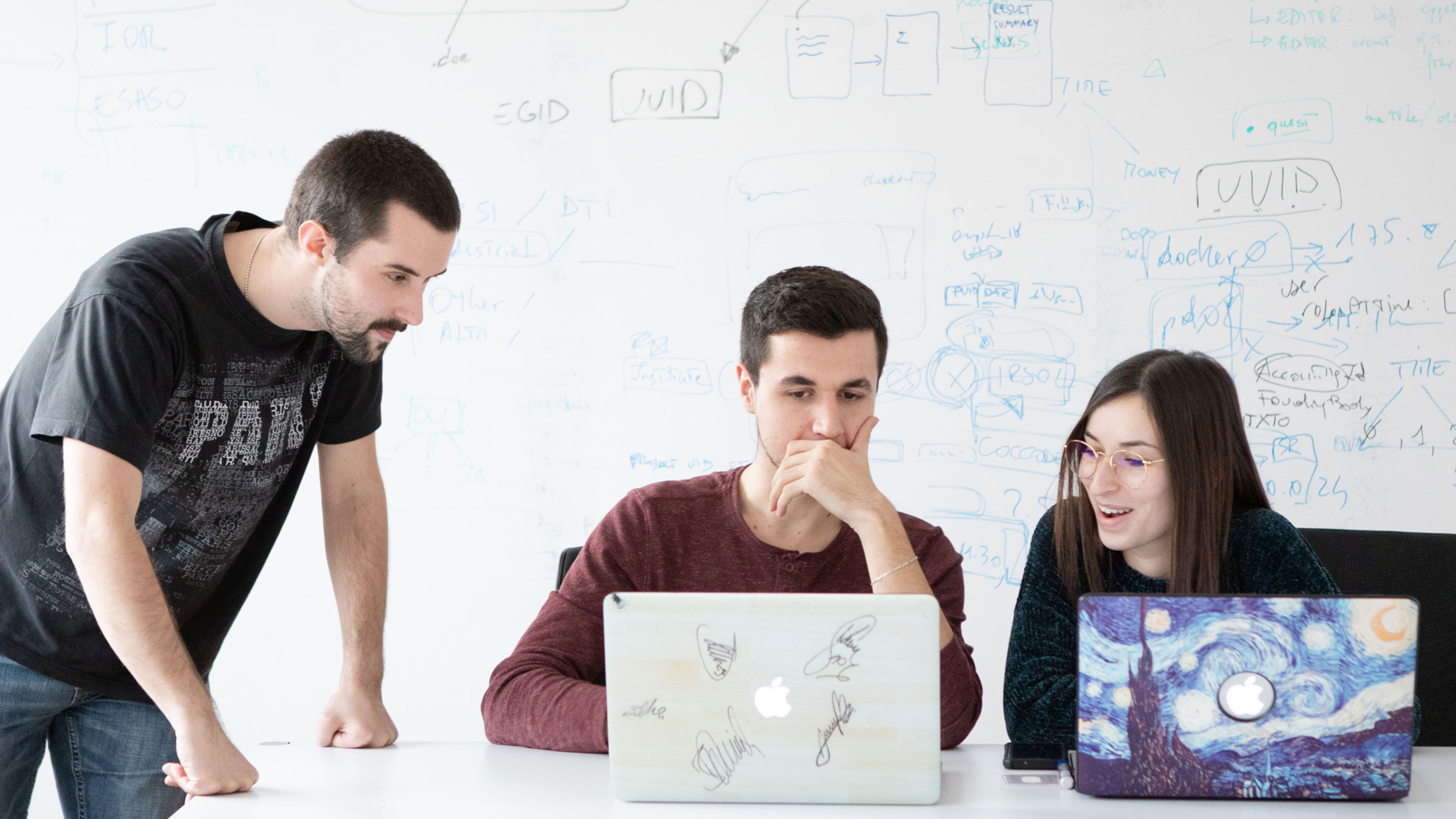
My name is Francesco Lelli and I'm taking post-doctorate studies at the
University of Lugano under the supervision of the
Dean Mehdi Jazayeri. Below you can find what triggers my research curiosity and where I'm providing my small contribution.
Browse around and if you see something of your interest let me know.
Have a nice day,
Francesco
Software Engineering is a complex socio-technical activity, due to the need for discussing and sharing knowledge among team members. This has raised the need for effective ways of sharing ideas, knowledge, and artifacts among groups and their members. The Social Aspect of Software Engineering process also demands computer support to facilitate the development by means of collaborative tools, applications and environments. This raises on the one hand the need for an effective way of sharing ideas and requirements among the group members and on the other hand the need to create tools that can support such collaboration.
Grid and Clouds refers to a set of technologies that provides the possibility to share or outsource storage space and computational power. Traditional developments in these technologies have concentrated on providing batch access to distributed computational and storage resources. However, the desire to access, control, and acquire data from pervasive, widely-networked and distributed instruments reflects the need to include such scientific equipment as sensors and probes in the Grid/Cloud world.
Peer to Peer (P2P) refers to distributed applications where each node has a similar role, they are therefore peers to each other. This is in contrast to the client-server scenario where a program at one site (the client) sends a request to a program at another site (the server) and awaits an answer. Peer to peer is not synonymous of file sharing or Distributed Hash Table (DHT) software like .NET and research projects like SETI rely on this paradigm. This approach can drastically simplify the deployment of complex, dynamic and pervasive systems but it also increases the complexity of the software design.
The words "Data Acquisition" refer to the process of extracting, combining, transforming and transporting data from source systems to generate data that can be manipulated from a computer. In modern High Energy Physics experiments such a process is called DAQ and it is built via parallel applications that run on a massive number of machines. Dedicated equipment collects, processes (filters and aggregates) and stores the data for future off-line analysis. These devices need to exchange data, without loss, as fast as it is being generated while monitoring and controling to ensure a coherent and uniform orchestration of the equipment.
Problem Solving, Fault tolerant and Autonomic Computing are disciplines devoted to the study on how to recover possible system faults. According to Murphy's law: "If anything simply cannot go wrong, it will anyway". In other words, it is impossible to build a "bullet proof" machine, but there are techniques that attempt to minimize the possibility of failure of mission critical components.
The majority of the presentations regarding Web 2.0 start with "there is not a clear definition of Web 2.0". Maybe this is true, but it is also true that systems based on these technologies support similar functionality to those based on Web Services. They have evolved in a more chaotic but remarkably successful fashion with service architectures that support a variety of protocols including those of Web and Grid services.